

What is agentic AI? It's artificial intelligence that works toward a goal with limited supervision. Give an agentic AI system an outcome and it plans the steps, uses tools such as email, a database or a web search, checks what happened and adjusts. "Agentic" comes from agency, the capacity to act on purpose. IBM defines it as a system that can accomplish a specific goal with limited supervision, and AWS describes it as an autonomous system that acts independently to achieve pre-determined goals.
A chatbot answers and then waits for your next question. An agentic system keeps going until the work is done or it needs a person to decide. Think of the coworker who answers your question versus the one who just handles it.
Last updated October 27, 2026.
How does agentic AI work?
Vendors describe the cycle in slightly different words. IBM lists perception, reasoning, goal setting, decision-making, execution, learning and orchestration. Google Cloud lists perception, reasoning, planning, action and reflection. Boil both down and you get a loop with five parts.
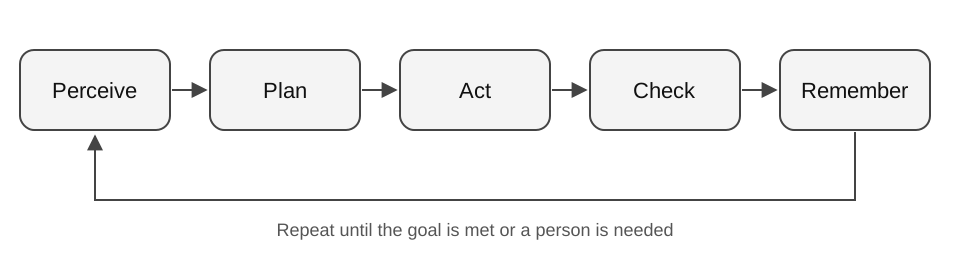
- Perceive. The system gathers context: your request, files, database rows, an inbox, a web page, the result of its last step.
- Plan. A large language model (LLM) breaks the goal into steps and picks the first one. If the goal changes or a step fails, it rewrites the plan.
- Act. Now it calls tools. A tool might be a search, an API call, a spreadsheet update or an email draft. Tools are how an LLM gets to change something outside a text box. IBM puts it this way: LLMs on their own cannot directly use external tools or databases, but agents can.
- Check. The system reads what its action produced. Did the search return what it needed? Did the record save? Then it carries on, retries or stops.
- Remember. It keeps instructions, past results and facts about your business, so the next step and the next run start with context. For details, see how AI agent memory works.
The loop is what turns one answer into a finished task. A single prompt gets you one response. A loop lets software work through a job with many steps and fix some of its own mistakes on the way. For a longer walkthrough, read how AI agents work.
Two design choices decide how much freedom a system gets. In a workflow, people write the path in advance and the steps follow it. In an agent, the model picks its own steps and tools. Anthropic draws this exact line in its guide to building agents and calls both kinds agentic systems. Most useful business setups mix the two: fixed steps where the process is known, model judgment where it isn't.
Agentic AI vs generative AI vs AI agents
These three terms overlap, and no source treats them the same way. MIT Sloan notes that there is no universally agreed definition of agentic AI. Here are the working distinctions.
- Generative AI creates content, such as text, images or code, from a prompt.
- AI agents are the individual workers. Each has a job, a set of tools and rules for when it may act.
- Agentic AI is the broader capability: the planning, acting and coordinating that agents do, and sometimes the system that coordinates several of them. Google Cloud calls agents the building blocks of agentic AI.
Generative AI is often the engine inside the other two. An agentic system uses a generative model to reason and to write, then wraps tools, memory and a loop around it. The model is the engine. The loop is everything that makes it go somewhere.
Each pair gets its own page here. Agentic AI vs generative AI covers what changes when a model gains tools. AI agents vs agentic AI covers why vendors use the two terms at different scales. If the agent side is new to you, start with what an AI agent is.
Agentic AI examples by business function
Most of these examples come from the vendor pages and research cited above. The rest are jobs teams hand to agents in practice. Each one pairs a repeatable task with a spot where a person stays in charge.
- Customer service: an agent reads an incoming question, finds the answer in product documentation and drafts the reply. Google Cloud lists customer service as a core use. A person reviews the draft before it goes out.
- Operations and scheduling: AWS describes an agent that adjusts an employee schedule when someone is off sick. It contacts the other employees and rebuilds the schedule within project limits.
- Supply chain: IBM describes agents that place orders with suppliers or change production schedules to keep inventory at the right level.
- Sales and revenue: an agent turns a recorded call into a follow-up email, next steps and proposed CRM updates, then waits for approval before anything sends or saves.
- Marketing and research: an agent checks competitor pages on a schedule and writes a short brief on what changed, with links to the sources.
- Software development: agents write code, run tests and debug. Anthropic notes that human review remains important for confirming a solution fits the wider system.
- Finance: Google Cloud lists fraud detection, risk assessment and investment strategies as areas where agents work on market data and statements.
MIT Sloan describes banks and retailers exploring agents for fraud detection, loan approvals and merchandise planning. To browse jobs that suit a small team, try the AI agent examples finder and the template library.
What are the risks of agentic AI?
Autonomy is the main benefit and the main risk. An agent that can act can also act wrongly, and it will do it at machine speed.
Anthropic states the trade-off directly: autonomous agents mean higher costs and the potential for compounding errors. One wrong early step can ride along through every later one. IBM warns that a poorly designed reward system can lead an agent to exploit loopholes and reach its target in unintended ways, and that failures can cascade across multi-agent systems.
The business risk is real too. Gartner predicts that over 40% of agentic AI projects will be canceled by the end of 2027, because of escalating costs, unclear business value or inadequate risk controls. The same release describes "agent washing", the rebranding of chatbots, assistants and robotic process automation without real agentic capability, and estimates that only about 130 of the thousands of agentic AI vendors are real. The first is a forecast and the second is an estimate. Neither is a measurement. They are still a good reason to ask a vendor to demo the loop above. Slides are cheap.
Guardrails that work
- Ask for approval before anything external. Emails, record changes, payments and posts wait for a yes. Read-only research can definately run freely. See human-in-the-loop AI agents for where to place approval gates.
- Scope the permissions. Give each agent only the tools and accounts its job needs. Start with read access.
- Keep a readable log. You should be able to see what occured at each step, and why.
- Start small. Pick a task where a wrong result costs minutes, not a customer.
- Feed it good data. MIT Sloan reports that in one research project, 80% of the work was data engineering, stakeholder alignment, governance and workflow integration, rather than prompt writing.
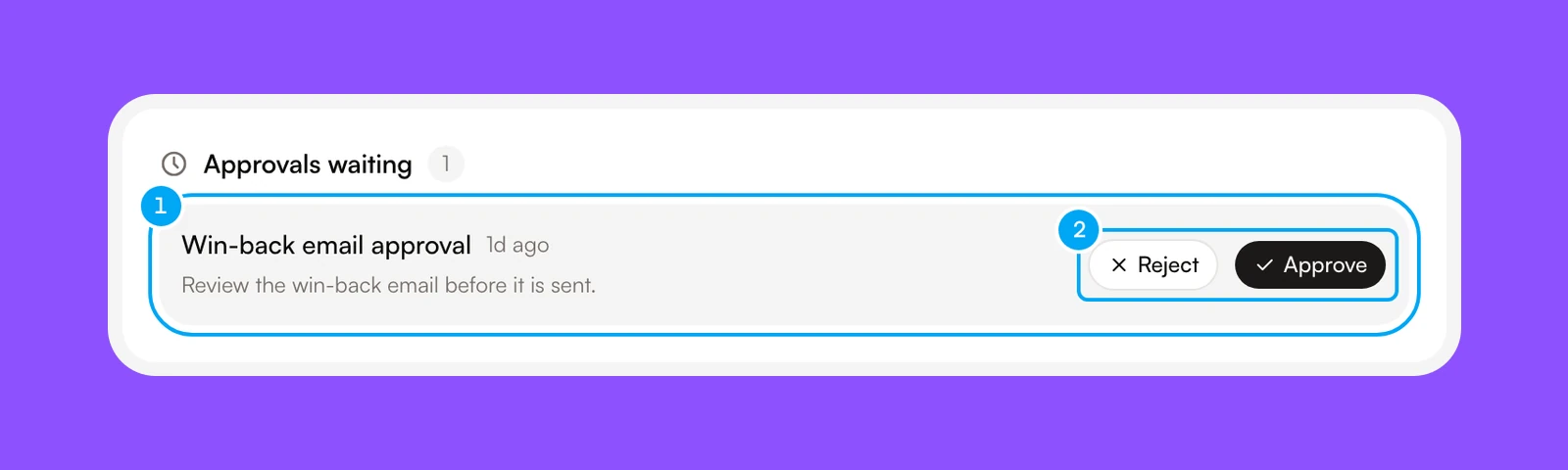
An approval gate looks like this in practice: the agent proposes one change, you read it, and you approve or reject.
More on this in AI agent guardrails.
How to start with agentic AI
Anthropic's advice is to find the simplest solution possible and add complexity only when needed, which may mean skipping the agent altogether. Here's a plan that follows from that:
- Choose one repeatable task. Pick work you do weekly, with a clear start and a clear finish, such as a competitor brief, a lead check or a support draft.
- Define "done" in plain words. Write down what a good result looks like, so you can judge it.
- Connect only what the task needs. One or two tools is plenty for a first run.
- Decide what needs your approval. Anything that sends, saves or spends waits for you.
- Run it, read the output and correct it. Then run it again on a schedule.
- Widen the scope slowly. Add tools or autonomy only after the agent gets several runs in a row right.
AI agents for beginners walks through a first project in more detail.
Where AI Agent fits
AI Agent is an AI workspace for you, your teams and your agents. You describe a job, connect your tools, and agents do the work while you approve what matters.
Here's how the pieces above show up in the product:
- Workflows and Autopilots: a workflow is a sequence of steps you build on a canvas, with Agent and Tool steps, conditions and Approval blocks. An Autopilot gives one agent a written task, a trigger and an output. The Workflows page is marked Beta in the product today.
- Approvals: when an agent proposes an action in chat, on a ticket, in a workflow or in an Autopilot, nothing runs until you approve it. Destructive tools are off by default and stay behind approval when enabled. A workflow can run certain writes on its own only after you allow them once, and you can revoke that permission.
- Connected tools: AI Agent exposes 50 connections carrying 6,581 tool actions.
- Knowledge, tickets and run history: agents read the knowledge you add, tickets track the work, and each run records its steps and outcome so you can check what happened.
The honest limit: AI Agent is hosted, so it doesn't run on your own infrastructure. It also asks for your approval a lot, on purpose. That suits teams that want oversight more than fully hands-off automation. Plans are on the pricing page.
Frequently asked questions
What is agentic AI in simple terms?
Agentic AI is AI that pursues a goal instead of only answering a question. It plans steps, uses tools, checks its own results and keeps going, and it asks a person when a decision needs one. Picture an assistant who does the task rather than a search box that hands you an answer.
What is an example of agentic AI?
A support agent reads a customer question, finds the answer in your documentation and drafts a reply for you to approve. Other examples are an agent that rebuilds a staff schedule when someone is sick, one that adjusts supplier orders to keep inventory steady, and one that briefs you weekly on competitor changes. See the examples above.
Is ChatGPT agentic AI?
A plain chat conversation isn't agentic, because you drive every turn. Some products, including OpenAI's, also offer agent features that browse and take actions on a multi-step task, and those do count. The test is whether the software plans and uses tools to finish a job. The brand on the box doesn't matter.
Is agentic AI safe to use at work?
It's as safe as the access and approvals you set. Scope each agent's tools, require approval for anything that leaves your organization, review the run log and start with low-stakes tasks. Gartner's forecast that over 40% of agentic projects will be canceled by 2027 cites weak risk controls as one cause, so controls are part of the job.
What is the difference between agentic AI and an AI agent?
An AI agent is one worker with a job, tools and rules. Agentic AI is the wider capability, and sometimes the system that coordinates several agents toward one outcome. Many sources use the terms interchangeably, so check what a vendor means. The full comparison is in AI agents vs agentic AI.